---
title: Rewarded Ads
description: Discover how Ad Manager Hub's Rewarded Ads use a value-exchange model to monetize premium content, driving massive engagement, high CTRs, and premium eCPMs.
---
[Skip to content](https://knowledge-base.optidigital.com/knowledge/rewarded-ads#main-content)
English
Show submenu for translations
[Create a ticket](https://knowledge-base.optidigital.com/knowledge/kb-tickets/new?hsLang=en) [Customer portal](https://knowledge-base.optidigital.com/tickets-view?hsLang=en)
.png?width=150&height=56&name=Logo%20-%20BG%20White%20(1).png)
Open main navigation
Close main navigation
- English
Show submenu for translations
- [Create a ticket](https://knowledge-base.optidigital.com/knowledge/kb-tickets/new)
- [Customer portal](https://knowledge-base.optidigital.com/tickets-view)
- Go to www.optidigital.com
Go to www.optidigital.com
Browse the Opti Digital platform, products, and capabilities
- There are no suggestions because the search field is empty.
1. [Help Center](https://knowledge-base.optidigital.com/knowledge?hsLang=en)
2. [Ad Manager Hub](https://knowledge-base.optidigital.com/knowledge/ad-manager-hub?hsLang=en)
3. [Ad Formats & Experiences](https://knowledge-base.optidigital.com/knowledge/ad-manager-hub?hsLang=en#ad-formats-experiences)
# Rewarded Ads
## Rewarded Ads format provides a premium, opt-in value exchange, allowing enterprise publishers to monetize high-value content effectively while achieving exceptional engagement rates.
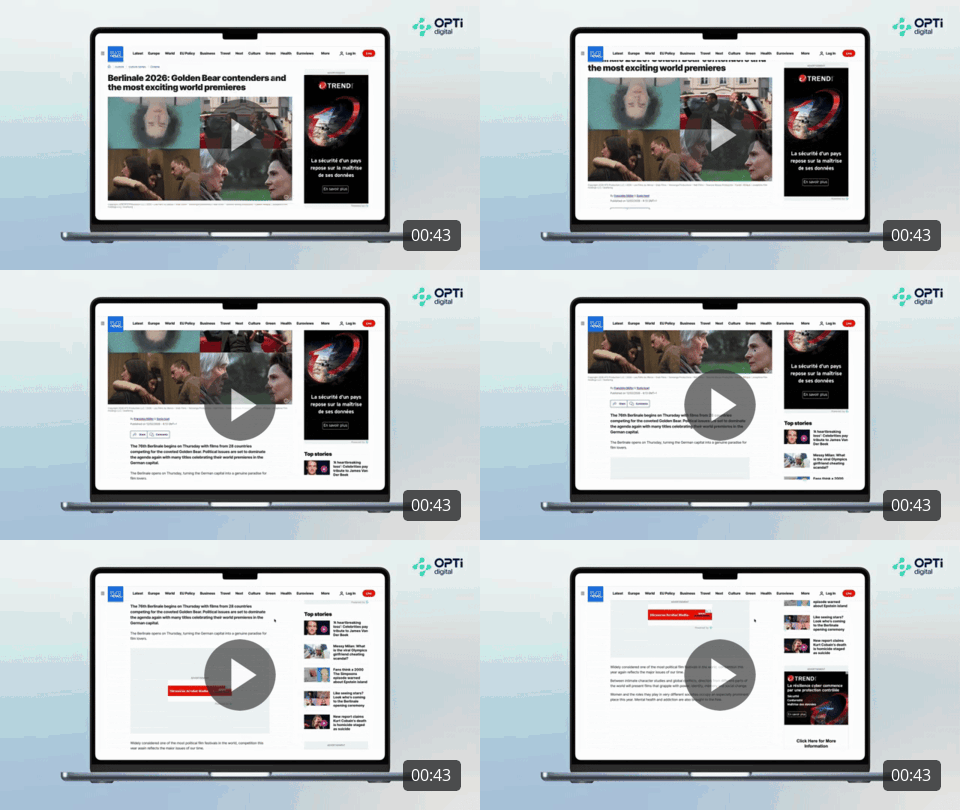
This format provides a non-intrusive, "value-exchange" solution where users actively choose to engage with an ad in order to unlock premium content or specific site features.
[](https://share.vidyard.com/watch/U94Hvcb5nJYmcuRQLDhHBy)
[Rewarded Ads Demo](https://share.vidyard.com/watch/U94Hvcb5nJYmcuRQLDhHBy)
**The 3-Step User Journey**
Rewarded Ads empower the audience through a seamless, 3-step opt-in process:
1. **Placement:** As the user scrolls through a high-value article, the text is partially blurred or gated. They encounter a clear, transparent prompt (e.g., *"Watch a quick ad to read the rest of the article"*).
2. **User Choice (Opt-In):** The user must actively choose to engage. If they opt in, they watch a short video ad. Because this is a conscious, requested action, the format sees staggering engagement—often reaching a **~95% completion rate**.
3. **Reward:** Immediately after the ad concludes, the premium article becomes fully available to read.
**The Strategic Impact for Publishers**
Implementing Rewarded Ads delivers exceptional, measurable benefits to your overarching monetization strategy:
- **Guaranteed Value & High eCPMs:** Because advertisers are guaranteed a highly engaged, captive audience with near-perfect completion rates, they bid aggressively. This format can command premium eCPMs (often an additional +30€).
- **A Protected User Experience:** It typically accounts for less than 5% of total impressions across a site, meaning you generate massive incremental revenue whilst impacting few users.
**Enterprise Best Practices & Scope**
Through Ad Manager Hub, your AdOps team has granular control over how and where this format triggers. You can customize the styling to align with your brand guidelines and set smart triggers—such as prompting the rewarded ad only after the user has read 50% of a long-form article.
**Important Technical Note:** To ensure optimal delivery and compliance, Rewarded Ads are presently supported exclusively for **Google demand**. This specific format does not currently utilize header bidding.
- [Ad Manager Hub](https://knowledge-base.optidigital.com/knowledge/ad-manager-hub?hsLang=en#main-content)
- [Overview](https://knowledge-base.optidigital.com/knowledge/ad-manager-hub?hsLang=en#overview)
- [Getting Started & Onboarding](https://knowledge-base.optidigital.com/knowledge/ad-manager-hub?hsLang=en#getting-started-onboarding)
- [Advanced Tag Capabilities](https://knowledge-base.optidigital.com/knowledge/ad-manager-hub?hsLang=en#advanced-tag-capabilities)
- [Ad Formats & Experiences](https://knowledge-base.optidigital.com/knowledge/ad-manager-hub?hsLang=en#ad-formats-experiences)
- [Demand & Header Bidding](https://knowledge-base.optidigital.com/knowledge/ad-manager-hub?hsLang=en#demand-header-bidding)
- [Yield & Pricing Optimization](https://knowledge-base.optidigital.com/knowledge/ad-manager-hub?hsLang=en#yield-pricing-optimization)
- [A/B Testing & Optimization](https://knowledge-base.optidigital.com/knowledge/ad-manager-hub?hsLang=en#a-b-testing-optimization)
- [Insights & Analytics](https://knowledge-base.optidigital.com/knowledge/ad-manager-hub?hsLang=en#insights-analytics)
- [Audience & Targeting](https://knowledge-base.optidigital.com/knowledge/ad-manager-hub?hsLang=en#audience-targeting)
- [FAQs](https://knowledge-base.optidigital.com/knowledge/ad-manager-hub?hsLang=en#faqs)
- [Demand Hub](https://knowledge-base.optidigital.com/knowledge/demand-hub?hsLang=en#main-content)
- [Overview](https://knowledge-base.optidigital.com/knowledge/demand-hub?hsLang=en#overview)
- [Getting Started & Onboarding](https://knowledge-base.optidigital.com/knowledge/demand-hub?hsLang=en#getting-started-onboarding)
- [User Experience](https://knowledge-base.optidigital.com/knowledge/demand-hub?hsLang=en#user-experience)
- [Invoicing and payments](https://knowledge-base.optidigital.com/knowledge/demand-hub?hsLang=en#invoicing-and-payments)
- [Q&A](https://knowledge-base.optidigital.com/knowledge/demand-hub?hsLang=en#qa)
- [Insights Hub](https://knowledge-base.optidigital.com/knowledge/insights-hub?hsLang=en#main-content)
- [Overview](https://knowledge-base.optidigital.com/knowledge/insights-hub?hsLang=en#overview)
- [Getting Started & Onboarding](https://knowledge-base.optidigital.com/knowledge/insights-hub?hsLang=en#getting-started-onboarding)
- [Pre-Built Analytics Dashboards](https://knowledge-base.optidigital.com/knowledge/insights-hub?hsLang=en#pre-built-analytics-dashboards)
- [Custom Reporting](https://knowledge-base.optidigital.com/knowledge/insights-hub?hsLang=en#custom-reporting)
- [Ad Experience Hub](https://knowledge-base.optidigital.com/knowledge/ad-experience-hub?hsLang=en#main-content)
- [Overview](https://knowledge-base.optidigital.com/knowledge/ad-experience-hub?hsLang=en#overview)
- [Getting Started & On Boarding](https://knowledge-base.optidigital.com/knowledge/ad-experience-hub?hsLang=en#getting-started-on-boarding)
- [Ad Formats & Experiences](https://knowledge-base.optidigital.com/knowledge/ad-experience-hub?hsLang=en#ad-formats-experiences)
- [Yield Hub](https://knowledge-base.optidigital.com/knowledge/yield-hub?hsLang=en#main-content)
- [Overview](https://knowledge-base.optidigital.com/knowledge/yield-hub?hsLang=en#overview)
- [Getting Started & Onboarding](https://knowledge-base.optidigital.com/knowledge/yield-hub?hsLang=en#getting-started-onboarding)
- [FAQ](https://knowledge-base.optidigital.com/knowledge/yield-hub?hsLang=en#faq)
- [Release Notes](https://knowledge-base.optidigital.com/knowledge/release-notes?hsLang=en#main-content)
- [2026](https://knowledge-base.optidigital.com/knowledge/release-notes?hsLang=en#2026)
[.png?width=64&height=24&name=Logo%20-%20BG%20White%20(1).png "Chill listening crop-3")](https://www.optidigital.com)
Help Center
Copyright © 2026, Opti Digital